Why Your Patio Goes Green Every Winter on the Sussex Coast
Coastal patios green over faster because salt in the air holds moisture against the stone, extending the damp hours algae needs well beyond the rainfall.
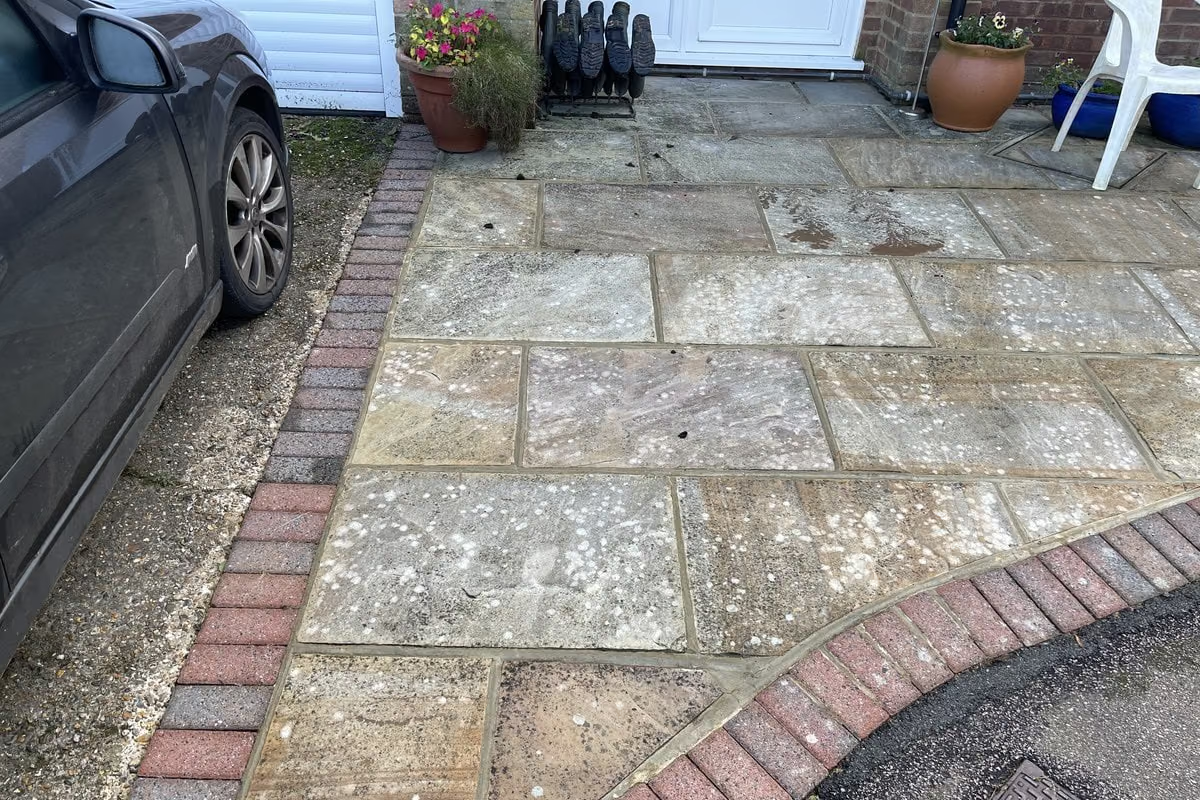
If you have moved to the coast from somewhere inland, the speed at which paving goes green here is one of the more annoying surprises.
The rainfall is not the explanation. Seaford is one of the drier parts of the country. The explanation is that the surface stays wet for longer, which is a different thing.
Damp hours, not rainfall
Algae does not care how much rain fell. It cares how many hours the surface was wet.
Two patios can receive identical rainfall and support completely different amounts of growth, if one dries in ninety minutes and the other takes six hours.
On the Sussex coast, three things push the drying time up.
One: salt holds water
This is the big one and it is the one almost nobody knows about.
Airborne salt from sea spray settles on every exposed surface within a few miles of the coast. It is not visible in any quantity, but it is there and it accumulates between rainfall events.
Salt is hygroscopic. It actively pulls water vapour out of the air and holds it. Below a certain relative humidity, roughly 75% for sodium chloride, salt sits there as a dry crystal. Above it, the crystal absorbs moisture and forms a film of brine.
Coastal winter humidity sits above that threshold a great deal of the time.
So a salted patio does not simply take longer to dry after rain. On a damp still evening it will pick up moisture from the air and become wet without any rain at all. That is the mechanism, and it is why the paving outside your back door feels damp on a morning when nothing has fallen.
Two: low winter sun
Between November and February the sun barely gets above 15 degrees of elevation at this latitude, and for much of the day it is lower than that.
A patio with a house, a fence or a hedge on its southern side is in shade for the entire day for months at a time, even in clear weather. The sun is simply never high enough to clear the obstruction.
That is why a patio can be fine all summer and green over between October and March. Its aspect has not changed. The sun’s has.
Three: mild coastal winters
The south coast rarely gets properly cold, which is pleasant and unhelpful.
Algae growth slows below about five degrees and largely stops near freezing. Inland Sussex gets weeks of that. The coastal strip frequently does not, so the growing season here effectively runs most of the year rather than stopping for the winter the way it does thirty miles north.
Mild, damp and dark is the ideal combination, and that is a coastal Sussex winter.
What follows from this
Cleaning alone will not change the outcome. You are removing the biomass, not the conditions. On an exposed coastal patio with poor winter sun, growth will be visible again within a year regardless of how thorough the wash was.
A biocide is worth more here than inland. It kills the residual population in the surface rather than just removing what you can see. On a coastal patio that is often the difference between annual and biennial cleaning, at £1.50 a square metre.
Sealing porous stone is worth considering. If the growth is getting into the stone rather than sitting on it, and on soft sandstone it is, an impregnating sealer denies it the habitat.
Rinsing matters. A wash that leaves salt-laden slurry to dry on the surface has put the salt straight back. I run a longer final rinse on coastal jobs for that reason.
What you can do for nothing
Improve the drying. Anything that gets more sun or more airflow onto the surface changes its behaviour materially. Cutting back a hedge on the southern side of a patio, or thinning a shrub that blocks the wind, can be worth more than any product.
Clear leaves promptly. A wet leaf holds a patch of water against the stone for weeks and stains it as well.
Check your gutters and downpipes. A surprising number of permanently green patches are directly beneath something that drips. If one corner of your patio is far worse than the rest, look up before you look down.
Move furniture occasionally. A permanently placed table leaves a permanently damp shadow.
The realistic expectation
An exposed north-facing patio at Seaford or Peacehaven will show visible growth within twelve months of a clean. With a biocide, eighteen to twenty-four.
A sheltered south-facing patio a mile inland might go three years.
Neither is a comment on the quality of the cleaning. It is where the patio lives, and knowing that is more useful than being told a product will fix it.
The moment it happens
There is a fairly reliable point in the year on this coast when patios turn, and it is worth knowing because it is the last useful moment to act.
Late September and early October. Two things coincide. The sun drops below the elevation where it clears fences and buildings for much of the day, and night-time humidity rises enough that surfaces stop drying properly between showers.
Growth that has been sitting dormant through a dry summer expands rapidly across about a fortnight, which is why people describe their patio as having gone green overnight. It did not; it had been there all along at a level you could not see.
An October clean catches it before it establishes properly and gets you through to spring looking reasonable. A March clean deals with a fully established mat.
The north wall effect
If one edge of your patio is far worse than the rest, and it runs along the north side of the house, that is not a coincidence and it is not fixable by cleaning harder.
That strip gets no direct sun between roughly October and March. It also gets whatever runs off the roof and the wall. It is the wettest, darkest part of your garden for half the year.
What actually helps there: check the gutter above it, because a slow drip is very often part of the story. Keep it swept. Take the biocide treatment, and accept that it will need doing before the rest of the patio does.
Some people do just that strip annually and the whole patio every three years, which is a sensible way to spend the money.
Why your neighbour’s is fine
The comparison that prompts a lot of calls.
Aspect, first. A few degrees of orientation changes how much winter sun a surface gets by a surprising amount when the sun is only 15 degrees up.
Shelter, second. A fence, a hedge, a garage, or simply being one row further back from the front changes salt deposition considerably.
Material, third. If theirs is porcelain and yours is sandstone, they will be cleaning theirs half as often for the rest of their lives.
Drainage, fourth. A patio with a proper fall dries in a fraction of the time of one that ponds.
None of those is about how well either patio was cleaned, which is usually the assumption.
Get a price
Send me a couple of photos
Fixed written quote, no visit needed for most jobs, and prices you can already check on this site before you ask.
Sent
That is with me.
I read every one myself. If you sent photos I can usually come back with a fixed price the same day, or the next morning if it arrives late.