Can You Jet Wash a Resin Bound Driveway?
Yes, carefully, at much lower pressure than block paving. The pressure limits that matter and the three ways people commonly wreck a resin surface.
Yes, and considerably more carefully than you would clean block paving.
Resin bound surfaces are one of the few driveway materials where the manufacturer’s own guidance gives you a pressure limit, and it is a lot lower than most people assume.
What resin bound actually is
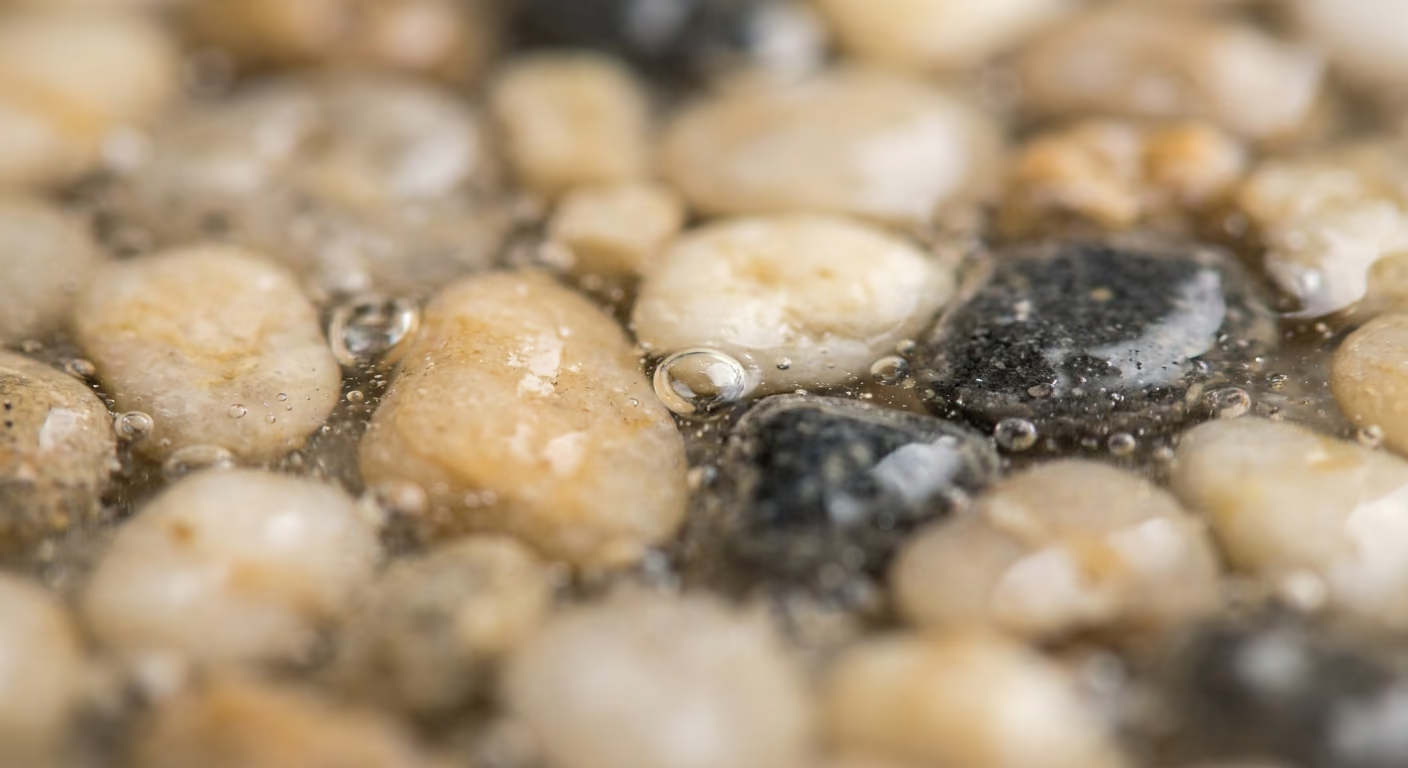
Aggregate, usually a graded natural gravel, mixed with a clear polyurethane or epoxy resin and trowelled out onto a solid base. The resin coats every stone and glues them to each other, leaving small voids between them so water drains through.
Two things follow from that construction.
It is porous by design. Water goes through the surface rather than running off it, which is why resin bound drives usually do not need planning permission for drainage.
The stones are held only by the resin film between them. There is no mechanical interlock the way there is in block paving. If the resin bond fails at a point, the stones there come loose.
This is different from resin bonded, which is a layer of resin with stone scattered onto the top. Resin bonded is not porous and is more fragile again. If you are not sure which you have, look at the edge: bound surfaces show stone all the way through the depth, bonded ones have a smooth resin layer underneath the loose-looking top.
The pressure limit
Most resin bound manufacturers specify a maximum of around 150 bar and a minimum standoff of roughly 200 to 300mm, with a fan nozzle of 25 degrees or wider.
For comparison, a domestic petrol washer runs at 180 to 250 bar and most people hold the lance a good deal closer than 300mm.
So the honest answer is that the machine is capable of damaging the surface and the operator’s discipline is what keeps it safe.
Check your own installer’s guidance if you still have it. Some warranties are explicit about pressure washing and a few are voided by it.
The three ways people wreck them
Stripping the resin film. Too much pressure at too short a standoff cuts the resin bond between stones. The immediate result is loose aggregate, which you will see coming away in the run-off. What follows is a patch that keeps shedding stone because each lost stone exposes more edges.
Blowing out a weak area. Resin surfaces sometimes have areas where the mix was slightly resin-poor when laid, often at edges or where the trowelling ran thin. Those areas fail first. A jet at pressure finds them, and what was a slightly weak patch becomes a hole.
Driving water into the base. Resin bound is porous, so water goes through it by design. That is fine with rain. It is less fine with a high pressure jet, which can drive a large volume into the sub-base quickly and, on a drive with poor base drainage, cause problems underneath.
How to do it properly
Wide fan, 25 degrees or more. Never a turbo nozzle, ever.
Long standoff, 300mm and up. Further than feels natural.
Keep moving. No dwelling on marks.
Work at an angle rather than straight down, so the jet lifts debris off rather than pushing water into the surface.
A rotary surface cleaner is actually a good tool here, precisely because the housing fixes the standoff and the jets never stop moving. Used at reduced pressure it is safer than a hand-held lance.
What resin drives actually need
Most of what makes a resin drive look tired is not something that needs pressure at all.
Surface algae responds to a biocide treatment far better than to a jet.
Silt and organic debris in the voids is what causes the more serious problem, which is loss of porosity. A resin drive that has stopped draining and now puddles has usually blinded with silt. That needs a gentle wash and sometimes a specialist vacuum, not more pressure.
Leaf staining on light coloured aggregate is a tannin stain in the resin and largely will not come out.
Weeds on a resin drive are growing in the surface debris rather than rooting into the material, so clearing the debris removes the growing medium.
Repairs
Small loose patches can be repaired with a resin repair kit, and it is worth doing early before the area spreads. The colour match on a weathered drive is never perfect.
Larger failures usually mean the original mix or the base was wrong, and that is a conversation with the installer rather than a cleaning job.
My own position
I will clean resin bound surfaces at reduced pressure and I quote them at the standard rate.
What I will not do is take a job where the drive is already shedding aggregate, because cleaning it will make that worse and I would be handing the customer a bill and a deteriorating drive. In that situation the honest advice is to get the surface repaired first.
The drainage problem, which matters more than the appearance
Most resin bound drives are laid partly because they are permeable, which avoids the planning requirements around surface water run-off.
That permeability degrades. Silt, organic debris and fine dust gradually blind the voids between the stones, and after five to ten years a drive that used to take rainfall straight through starts to puddle.
You can test it in two minutes. Tip a bucket of water onto the middle of the drive. On a healthy surface it disappears almost immediately. If it spreads and sits, the surface has blinded.
Cleaning helps, if it is the right kind of cleaning. Gentle washing with plenty of water flushes fines out of the voids. Aggressive washing drives them further in and can push them into the base.
Severely blinded surfaces sometimes need specialist vacuum equipment, the same principle used on permeable block paving. That is not a jet washing job.
What each problem actually needs
Green film. Biocide, then time. Not pressure.
Leaf and needle debris in the voids. A leaf blower or a soft brush, regularly. This is the maintenance that matters most and it is free.
Puddling. Gentle flushing, as above, or specialist vacuum.
Loose stones in one area. A resin repair kit, before it spreads.
Oil. A degreaser with dwell time. Resin surfaces are more resistant to oil than concrete but the aggregate can hold it.
Tyre marks. Usually rubber transfer, which lifts with a degreaser. Sometimes it is the resin discolouring from hot tyres, which is permanent.
Yellowing overall. UV degradation of the resin, particularly on cheaper epoxy systems. Not removable. UV-stable polyurethane resins do not do this, which is worth knowing if you are having one laid.
Before you let anybody near it
Two questions.
Ask what pressure they will use and what nozzle. If the answer does not involve a number under about 150 bar and a wide fan, find somebody else.
Ask whether they have cleaned resin bound before. It is different enough from block paving that experience matters, and there is no shame in a contractor saying it is not their surface. I would rather turn a job down than damage one.
If your drive is under ten years old, check whether you still have an installer warranty and what it says about cleaning. Some are specific.
Get a price
Send me a couple of photos
Fixed written quote, no visit needed for most jobs, and prices you can already check on this site before you ask.
Sent
That is with me.
I read every one myself. If you sent photos I can usually come back with a fixed price the same day, or the next morning if it arrives late.